Skylab: Rescue, Record Crews and Re-entry of NASA’s First Station
The short version
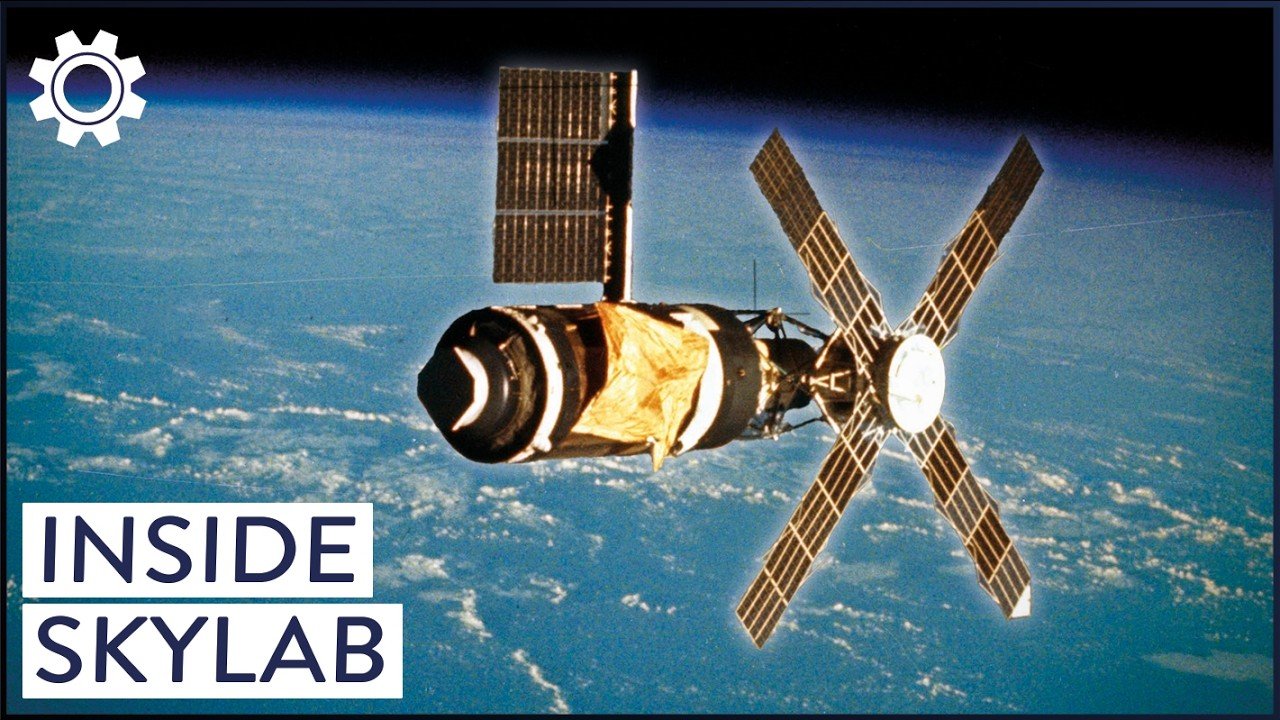
A documentary history of Skylab, NASA's first space station, built from Apollo-era hardware. It covers the launch damage that tore off the meteoroid shield and one solar panel, the 10-day rescue effort with a parasol and a spacewalk, and the three crews that followed, ending with the station's uncontrolled-but-steered re-entry over the Indian Ocean and Australia.
Full written account
Skylab, NASA's first space station, lost its meteoroid shield and one of its two solar panels 1 minute and 3 seconds after liftoff on a Saturn V, the last one ever flown. Ten days later a crew was cutting a metal strap with a 25 ft pole to free the remaining panel. The episode shaped everything that followed in long-duration spaceflight.
Building a station from Apollo hardware
Werner von Braun proposed using Apollo-era hardware for an orbiting laboratory he called Skylab. The Apollo command and service module served as the taxi, the third stage of a Saturn V became the living quarters, and the Apollo telescope mount served as the station's observatory. The plan called for three astronaut crews on flights of 28 to 56 days.
Training relied on a neutral buoyancy tank at Marshall Space Flight Center in Huntsville, Alabama: 75 ft in diameter, filled to 40 ft with about a million and a half gallons of water, with full-size sections of the station inside. Engineers also insisted on a window.
Launch damage
Telemetry showed trouble 1 minute 3 seconds after liftoff. Internal temperatures ran from 170 to 190°F, and external skin temperatures between 240 and 300°F. At maximum dynamic pressure the meteoroid shield was ripped off, exposing the habitat's skin to the Sun. One solar panel deployed and was torn away. The other was held in place by a small strap of metal from the shield, which prevented it from deploying but also saved it.
The first crew's launch, due the next day, was delayed by 10 days.
The 10-day fix
Teams across NASA and its contractors worked around the clock. The solution for heat was a parasol, sewn by seamstresses and pushed out through a small science airlock. For the panel, crews trained underwater to cut the strap with large cutters on a 25 ft pole.
Pete Conrad, Joe Kerwin and PJ Weitz launched on 25 May. They found the station wounded, with one wing gone and the other partly deployed. After docking they found a breathable but hot, dark station. Conrad deployed the parasol through the airlock in about four hours, and temperatures began to fall after about two revolutions. During the spacewalk, there were no handrails or foot restraints in the area. Conrad reported the strap was cut, and the panel came free, giving power.
The later crews
The first crew returned after a record 28 days. The second crew, nicknamed the Super Crew, spent 59 days in space and accomplished 150% of its objectives.
The third crew, Jerry Carr, Bill Pogue and Ed Gibson, had no spaceflight experience. Pogue became sick and the crew chose not to tell Mission Control, but recordings downloaded at day's end revealed it. Tasks were then scheduled to the minute, the crew skipped rest days and made mistakes, and one day none of them answered a scheduled radio check. Open discussion followed, and Mission Control let the astronauts decide when and in what order to do their work. The crew returned after a record 84 days.
Re-entry
Skylab was expected to stay up into the 1980s, with the Space Shuttle possibly boosting it, but heightened solar activity made it drop out of orbit. It was over 100 ft long and weighed 77 tons. With no engine to fire for a retro burn, NASA controlled only its orientation, and commanded it to tumble to bring it down over an unpopulated area. An airline pilot near Perth saw it, and estimates put it at 20 to 50 pieces. Skylab impacted in the southern Indian Ocean southwest of Australia, with no reports of damage or injury. Australia fined the United States government $400 for littering.
Questions this video answers
What went wrong when Skylab launched?
About 1 minute 3 seconds after liftoff the meteoroid shield was ripped off. One solar panel was torn away and the other was held by a small metal strap.
How was Skylab repaired?
The first crew deployed a solar parasol through an airlock to cool the workshop, then cut the strap on the jammed solar panel with cutters on a 25 ft pole.
How long did the crews stay in space?
The first crew stayed a record 28 days, the second 59 days and the third 84 days.
How did Skylab end?
Solar activity made it drop out of orbit. NASA tumbled it to bring it down over an unpopulated area, and it impacted in the southern Indian Ocean southwest of Australia, with no reports of injury.
What happened to Salute's crew?
The three cosmonauts died after an air pressure valve malfunctioned during re-entry; they suffocated within 2 minutes.