How the ISS Was Assembled: Modules, Gyros, Canadarm2 and Cooling
The short version
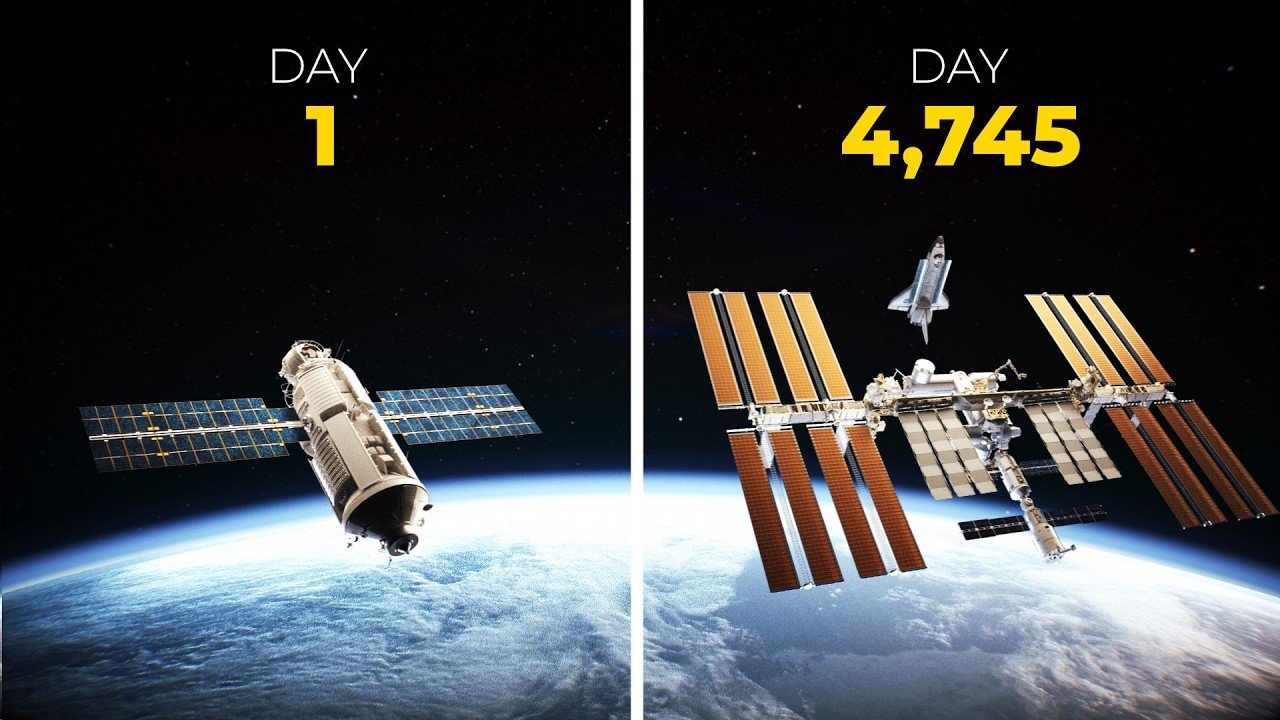
This documentary-style explainer covers the early assembly of the International Space Station, from Zarya and Unity in 1998 through the 14 shuttle missions up to 2003. It covers docking and berthing systems, the 51.6° orbit, control moment gyroscopes, Canadarm2, the Quest airlock and the ammonia cooling loops, with retired astronaut Scott Parazynski describing his experiences.
Full written account
The International Space Station orbits at 51.6°, a figure calculated to the tenth of a degree. Launching from Baikonur at exactly that inclination means a rocket would barely scratch the border of China, so spent Russian booster stages would never fall on Chinese soil. The orbit was originally planned at 28° for NASA's Space Station Freedom, which was good for Florida launches but unreachable from Soviet sites in Kazakhstan. After the Cold War it was changed to bring in Russia.
The first modules
In late 1998 a Proton rocket carried Zarya, a powered control module with attitude controls, batteries, fuel, solar panels and propulsion. Two weeks later Space Shuttle Endeavour brought Unity, a 5.4 m long connecting hub with four docking ports along its walls and two more on its ends. Unity launched with two pressurized mating adapters, one side fitted for the androgynous docking system and the other for the American berthing mechanism.
Docking and berthing
Earlier probe and drogue systems offered only a narrow passageway. The androgynous peripheral attached system has identical sides, each with a ring of three petals; after soft capture the ring retracts and 12 latches form an airtight seal. Retired astronaut Scott Parazynski described STS-86, the first mission back to Mir after its collision with a Progress ship. The station was 6.5° off-axis because its crew had chosen the wrong star in a star alignment, and the shuttle crew corrected by hand to dock.
The common berthing mechanism, by contrast, grabs modules and maneuvers them into place. Its larger cross-section lets lab racks pass through hatches, but its bolting sequence takes time, so it is less suited to emergencies.
Becoming a home
Zvezda launched in July 2000 on a Proton with a Pizza Hut logo. It carried electrolysis, carbon dioxide scrubbers, humidity filters and fans, along with two main engines and 32 attitude thrusters. The Z1 truss, delivered on STS-92, carried the first control moment gyroscopes, S-band and Ku-band antennas, and temporary solar panels. Expedition 1 arrived on a Soyuz in late 2000, living mainly in Zvezda and Zarya. The P6 truss brought the first large US solar panels, in a temporary position, and the station used nickel hydrogen batteries of about 81 amp-hours.
Gyroscopes and attitude control
Destiny, delivered on STS-98 in February 2001, brought enough computing power to spin up the 95 kg gyroscopes to 6,000 revolutions per minute. Three are needed and a fourth is a backup. When they saturate, Zvezda thrusters desaturate them while also raising the orbit by 1 to 2 meters per second. In June 2002 one gyroscope began to vibrate and its bearings failed from overheating, requiring spacewalks to replace it.
Canadarm2 and the airlock
On STS-100, Parazynski and Chris Hadfield unfurled Canadarm2 by hand. It has seven motorized joints, latching end effectors on both ends and can move from one grapple fixture to another. The Quest airlock, installed on the next flight, let spacewalks happen without sealing the shuttle crew off from the station. STS-110 delivered the S0 truss, and STS-111 brought the mobile base system.
Cooling
External loops use ammonia, which stays liquid in the cold and is lighter than water. Because it is toxic it stays outside, with an internal water loop exchanging heat. Radiator wings rotate 210° through the thermal radiator rotary joint. Between 1998 and 2003, 14 shuttle missions assembled four main pressurized modules. Destiny's cables were miswired, Quest developed small leaks and Canadarm2 lost a motor soon after activation.
Questions this video answers
Why does the ISS orbit at 51.6 degrees?
The orbit was changed from Freedom's planned 28° to 51.6° to bring in Russia. Launching from Baikonur at exactly 51.6° keeps the rocket from barely scratching China's border, so spent Russian booster stages would not fall on Chinese soil.
What were the first ISS modules?
A Proton rocket launched Zarya in late 1998. Two weeks later Space Shuttle Endeavour carried Unity, which acts as a connecting hub.
How many shuttle missions built the early ISS?
Fourteen shuttle missions assembled four main pressurized modules along with truss and airlock components between 1998 and 2003.
Why does the ISS use ammonia for external cooling?
Ammonia stays liquid in the cold of space and is lighter than water for the same heat-carrying capacity. Because it is toxic, it stays outside the pressurized modules, and an inside water loop exchanges heat with it.
How is the ISS orientation controlled?
Control moment gyroscopes control the station's attitude without burning propellant. Thrusters on the Zvezda module desaturate them when they reach their torque limits.