ISS History: Assembly, Crises and the Plan to Deorbit by 2030
The short version
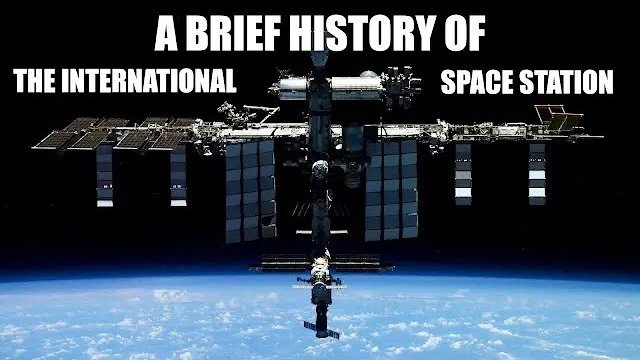
A long-form history of the International Space Station, from early station proposals and Space Station Freedom through the Shuttle-era assembly, Expeditions, the Columbia pause, commercial cargo and crew vehicles, and the planned 2030 deorbit. It also covers incidents such as the 2013 spacewalk water leak, the 2018 Soyuz hole and the Nauka thruster firing, and the commercial stations planned to follow.
Full written account
In late 2024 a plan was settled to end the International Space Station, which has orbited about 400 km overhead since 1998. In 2030, SpaceX is to use a modified Cargo Dragon to send the station on a controlled re-entry toward Point Nemo, the most isolated spot in the South Pacific. Most of the structure is expected to be torn apart and reduced to ash by aerodynamic forces. By then humans will have lived in low Earth orbit continuously for 32 years.
From Apollo to Freedom
The station's roots lie in the end of the space race. The US weighed three themes: a crewed mission to Mars, a permanent space station, and a logistics vehicle to build it. With a major federal budget deficit, President Nixon chose the logistics vehicle, which became the Space Shuttle. The Apollo-Soyuz Test Project of 1975 was the only early joint idea to come to fruition. The Soviet Union began Mir in 1986 as the first modular station, while the US planned Space Station Freedom, announced by President Reagan in 1984.
Freedom's schedule slipped as budgets shrank. The first plan called for assembly over 12 shuttle flights beginning in 1992, but the fiscal 1985 budget was cut by around $85 million. A dual-keel redesign put pressurized modules at the centre with solar arrays on either side, and final 10-year development contracts were signed in 1988. By 1993, further redesigns brought in international partners, using 75% of Freedom's hardware designs plus Russia's Mir 2 concept, a European module and a Japanese module. The US also flew 11 shuttle visits to Mir, from STS-71 in 1995 to STS-91 in 1998, to practise docking. On January 28th, 1998, 15 governments signed the space station intergovernmental agreement.
Assembly begins
Zarya launched on a Proton on November 20th, 1998. Built in Moscow from 1994 to 1998 but funded entirely by the United States, it cost roughly half of Lockheed Martin's proposed alternative. A twin built for contingency was shelved. Unity followed on STS-88 aboard Endeavour on December 4th, 1998. At 2:54 PM EST on December 10th, Commander Bob Cabana and cosmonaut Sergey Krikalev entered the station for the first time.
The station then lay dormant for two years while Zvezda was readied. Russia's financial struggles delayed it, a Proton failure in October 1999 delayed it further, and NASA administrator Daniel Goldin accused Russia of dragging its feet. Zvezda launched on July 12th, 2000, on a Proton carrying a Pizza Hut logo, an advertisement worth $1 million, and docked on July 26th. The Z1 truss arrived on STS-92, the 100th shuttle flight.
Expedition 1, Krikalev, Yuri Gidzenko and William Shepherd, launched on Soyuz TM-31 on October 31st and began a 136-day stay and the uninterrupted human presence that continues. When Progress M14's automatic docking failed, Gidzenko docked it manually, which raised eyebrows because a similar practice attempt at Mir in 1997 had caused a collision. STS-97 brought the P6 truss and the first large solar arrays, each 115 ft long. In 2001 Destiny arrived on STS-98 with five of its 24 rack positions filled, and Canadarm2 followed on STS-100. Dennis Tito flew as the first space tourist, which Goldin criticized. Quest joint airlock arrived on STS-104.
Columbia and the truss
On September 11th, 2001, astronaut Frank Culbertson was the only American not on Earth and photographed smoke over Manhattan. The S0 truss, mobile transporter and mobile base system were installed in 2002. After Columbia was destroyed on STS-107, killing all seven crew, the shuttle fleet was grounded and the station was supplied only by Soyuz and Progress until July 2005. Expedition 7 was reduced to two people, and the centrifuge accommodations module was cancelled. STS-114 returned to flight in July 2005 and flipped Discovery through a 360° pitch so the crew could inspect it for damage.
Assembly resumed with the P3/P4, P5, S3/S4 and S5 trusses. P2 and S2 were cancelled because reboost thrusters were not needed. In October 2007 STS-120 brought Harmony. When a solar array tear appeared at a hinge, crew made cuff links from spare wiring and a spacewalker, riding the orbiter boom sensor system on Canadarm2, installed them. The Columbus laboratory arrived in February 2008, Japan's Kibo came in three flights from 2008, and Dextre came on STS-123. The S6 truss, delivered on STS-119 in March 2009, completed the integrated truss structure.
Troubles aboard
- May 21st, 2008: the 7-year-old toilet in Zvezda failed after its gas liquid separator pump broke, and the crew used the toilet on a docked Soyuz.
- March 12th, 2009: debris from a Delta 2 upper stage was reassessed as a high threat too late for a manoeuvre. The Expedition 18 crew sheltered in the docked Soyuz and the object passed without contact.
- July 2010: an ammonia pump module failed, shutting down two of four gyroscopes and other equipment. A spacewalk replaced it.
- July 16th, 2013: Luca Parmitano saw water inside his helmet during a spacewalk planned for over 6 hours, ended after 1 hour. A clogged filter was the cause, and NASA found earlier warning signs had been dismissed.
- August 2018: a 2 mm hole was found in Soyuz MS-09's orbital module and sealed with epoxy. No evidence has been presented for any theory of who drilled it.
- July 2021: after docking, Nauka's thrusters fired in error, spinning the station a rotation and a half over 44 minutes.
Later years
Expedition 20 raised crews from three to six in 2009. Tranquility and the Cupola arrived on STS-130, Rassvet on STS-132. Discovery flew its final mission, STS-133, on February 24th, 2011, and Atlantis flew the last shuttle flight, STS-135. SpaceX's COTS Demo Flight 2 reached the station in May 2012, and Don Pettit said the Dragon smelled like a brand new car. Scott Kelly and Mikhail Kornienko spent 340 days in space, and the Twins Study found Kelly's telomeres lengthened by about 14.5% before returning to normal within six months of landing. BEAM arrived in 2016 and cannot stay beyond 2028. IROSA solar arrays arrived on CRS-22 in 2021. Crew Dragon's Demo-2, with Doug Hurley and Bob Behnken, docked on May 31st, 2020.
The station's cost was $3.6 billion above its original $17 billion price, and it takes about a third of the human spaceflight budget at $3 billion a year. NASA expects to save about $1.5 billion a year after retirement by renting from commercial stations proposed by Axiom Space, Vast, Blue Origin with Sierra Space, and Starlab Space.
Questions this video answers
How is the ISS planned to be brought down?
A modified SpaceX cargo Dragon is to send the station on a controlled re-entry in 2030 toward Point Nemo in the South Pacific.
When did ISS assembly begin?
Zarya launched on a Proton rocket on November 20, 1998, beginning assembly.
Who was the first long-term crew?
Expedition 1 launched on Soyuz TM-31 on October 31 and began the uninterrupted human presence in space; it lasted 136 days.
How much has the ISS cost?
NASA said it would cost $3.6 billion more than the original $17 billion price, and it takes about $3 billion a year to operate and maintain.
Which companies plan commercial stations?
Axiom Space, Vast, Blue Origin with Sierra Space (Orbital Reef), and Starlab Space.