Spacewalk 99: Adenot and Meir Replace Harmony Retroreflector
The short version
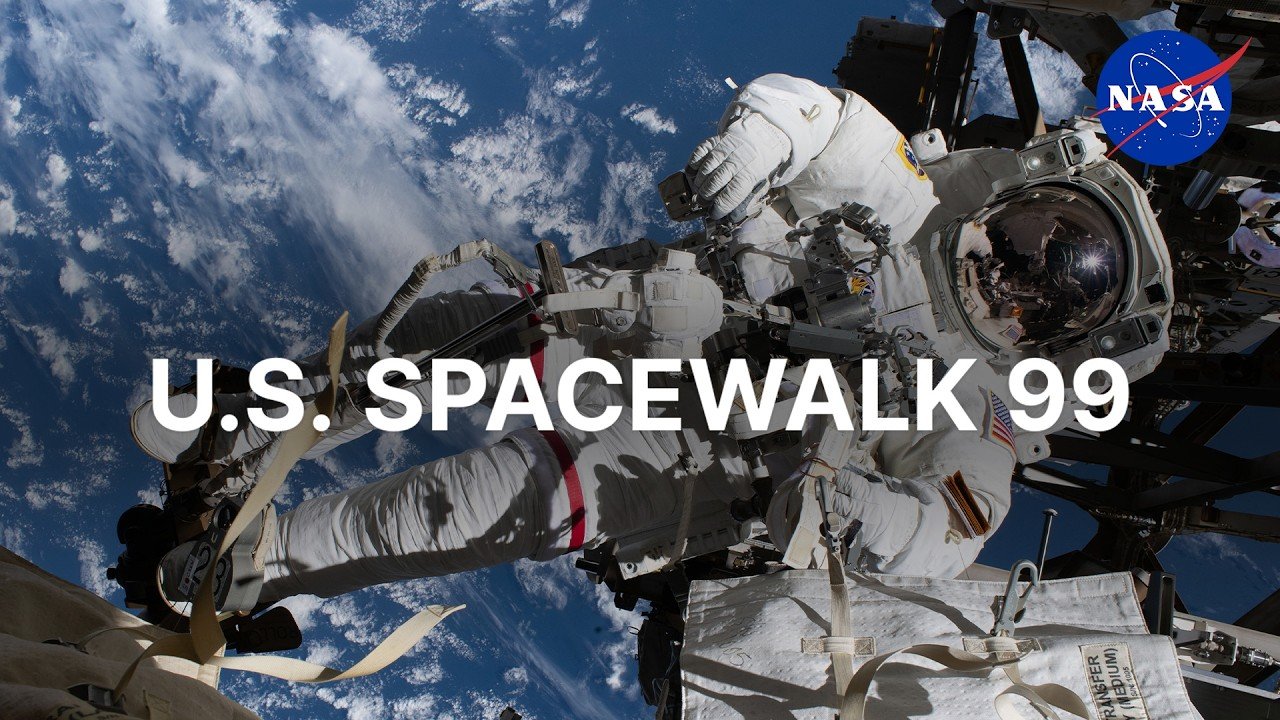
NASA's live coverage of U.S. Spacewalk 99, in which ESA astronaut Sophie Adenot and NASA astronaut Jessica Meir worked outside the International Space Station. Their tasks were to replace a retroreflector on the forward port of the Harmony module, install jumper cables for data relay systems, prepare the Alpha Magnetic Spectrometer's radiator for future maintenance, and replace a high-definition camera on the truss. The coverage runs from suit-up and depressurization through the first hours outside, including the removal of the failed retroreflector and camera.
Full written account
A retroreflector on the forward port of the International Space Station's Harmony module, browned by thruster contamination from years of visiting-spacecraft dockings, was the main reason for U.S. Spacewalk 99 on September 1, 2026. NASA described the reflector as still performing, but slightly degraded, and the crew went out to replace it. It supports spacecraft navigation during rendezvous and docking operations, so its condition matters to every vehicle that approaches that port.
The spacewalkers were ESA astronaut Sophie Adenot and NASA astronaut Jessica Meir. It was the 284th spacewalk in support of space station assembly, maintenance and upgrades, the seventh spacewalk out of the station in 2026, and the fourth for Expedition 75. The coverage also called it the fourth spacewalk in less than a month and the sixth all-female spacewalk.
The crew and the numbers
Adenot, wearing the suit with red stripes, was designated EV1 and made her third spacewalk. Meir wore the unmarked suit as EV2 and made her seventh. NASA said the walk would move Meir into third place all-time for total spacewalks among women at NASA, behind Peggy Whitson with 10 and Sunita Williams with nine.
Inside the Quest airlock, NASA astronauts Jack Hathaway and Anil Menon helped suit them up. Both were completing their first spaceflights. Menon launched aboard Soyuz MS-29 in July and had already completed three spacewalks. Hathaway launched with Crew 12 alongside Meir, Adenot and Roscosmos cosmonaut Andrey Fedyaev. Crew 12 launched on February 13 and arrived at the station the next day aboard the SpaceX Dragon named Freedom, which was still docked to the zenith port of Harmony.
On the ground, Chloe Mering led the Orbit 2 flight control team. Tess Caswell was Capcom. NASA astronaut Mark Vande Hei, who has spent 523 days in space and completed over 26 hours of spacewalks, served as ground IV, the spacewalk communicator.
Getting outside
The suits were Extravehicular Mobility Units, each described as a human-sized spacecraft with its own portable life support. The suit has six layers and provides atmospheric containment, thermal insulation, cooling, solar radiation protection and micrometeoroid protection. At nominal pressure the suit is about 4.3 psi.
Before leaving, the crew completed the in-suit light exercise protocol, a series of 10 exercises with short breaks between them, to help purge excess nitrogen from the blood. Each spacewalker then had a SAFER installed, the Simplified Aid for EVA Rescue, a compressed-nitrogen-powered backpack that lets an untethered crew member maneuver back to the station. NASA did not expect it to be needed, since crews train at the Neutral Buoyancy Lab to stay tethered at all times.
Depressurization of the crew lock ran in two stages, from about 14.7 psi down to 5 psi, where it paused for system checks, then on to vacuum. Hatch checks followed, with the EVA hatch gauge reading about 0.5 psi before Adenot opened it. The spacewalk officially began at 7:40 a.m. Central Time when both crew members switched their suits to internal battery power. About 11 minutes later they were still working to get bags, tools and tethers configured outside the airlock. Buddy checks, including the helmet absorption pad check, came before they separated for their work sites.
Replacing the retroreflector
Adenot translated to the Node 2 forward reflector site, with Vande Hei reading cautions along the route, including keeping an 18-inch keep-out zone from blind mate connector plug 35. She first photographed the failed planar reflector, then released its three bolts with a ratchet wrench set to counterclockwise. The procedure called for one turn on each bolt first, then exactly eight turns on each, with Adenot working four turns per bolt in two rounds. Because the reflector had no soft dock, it floated free once released, and two additional turns were needed on bolts one and three to pop them out. She stowed the failed reflector in an empty EVA wipe.
For the spare, the bolts went in two turns by hand, then six additional turns, then three to nine turns with the palm wheel until snug with no gap. Bolts one and two were flush and snug, but bolt three had a higher torque and still showed a gap. After slightly adjusting her body position, Adenot used the thumb wheel and took about three turns, plus or minus half a turn, until there was no gap. Controllers confirmed a good installation and asked for a wiggle test on the spare planar reflector.
The high-definition camera
Meir moved to the S1 truss. She stowed an ORU bag, then installed an articulating portable foot restraint on the end of Canadarm2, operated from inside by Hathaway. His moves were called out in centimeters, such as body down 20 cm, with brakes off and on around each one.
At the work site Meir noticed three micrometeorite hits on the camera surface facing her. Controllers warned her to take extra care about sharp edges. She installed the scoop and window cover on the failed camera, loosened a wire tie, and demated the cables, the white cable, the light jumper cable and the PTU cable, in that order. The light jumper cable had to be demated before the PTU cable.
The camera itself would not slide out. With the cam lever at 90 degrees, it moved only a couple of centimeters. Controllers suggested cycling the lever, keeping the same plane and not twisting the long rail, and pushing down on the window cover with up to 45 lb of force. Meir asked for more head-up positioning from Hathaway, and Mission Control applauded when the camera came free during her seventh spacewalk. Controllers noted it had probably been side-loaded and that her hands needed to be closer to the frame.
About 2 hours into the spacewalk, the failed camera had been removed and the failed retroreflector replaced in progress. Meir then began installing the spare camera. The cables got in the way, and she was reluctant to release her end effector, so controllers advised pulling it out, unlocking it and locking it for more slack. She reported the camera slid to a hard stop and looked flush with her wrist mirror. The next step was mating the PTU cable before the light jumper cable.
Questions this video answers
Who performed the spacewalk?
ESA astronaut Sophie Adenot (EV1, red-striped suit) and NASA astronaut Jessica Meir (EV2, unmarked suit).
What was the main task?
Replacing the retroreflector on the forward port of the Harmony module, which supports navigation during rendezvous and docking.
Why was the retroreflector replaced?
Thruster contamination from dockings of visiting spacecraft has slightly degraded its performance, though it was still working.
Who operated Canadarm2?
NASA astronaut Jack Hathaway operated it from inside the station while Meir rode the arm.
What milestones did the spacewalk mark?
It was the 284th spacewalk for station assembly, maintenance and upgrades, and the sixth all-female spacewalk.