Why the ISS Will Be Deorbited: Aging Hardware and a Planned End
The short version
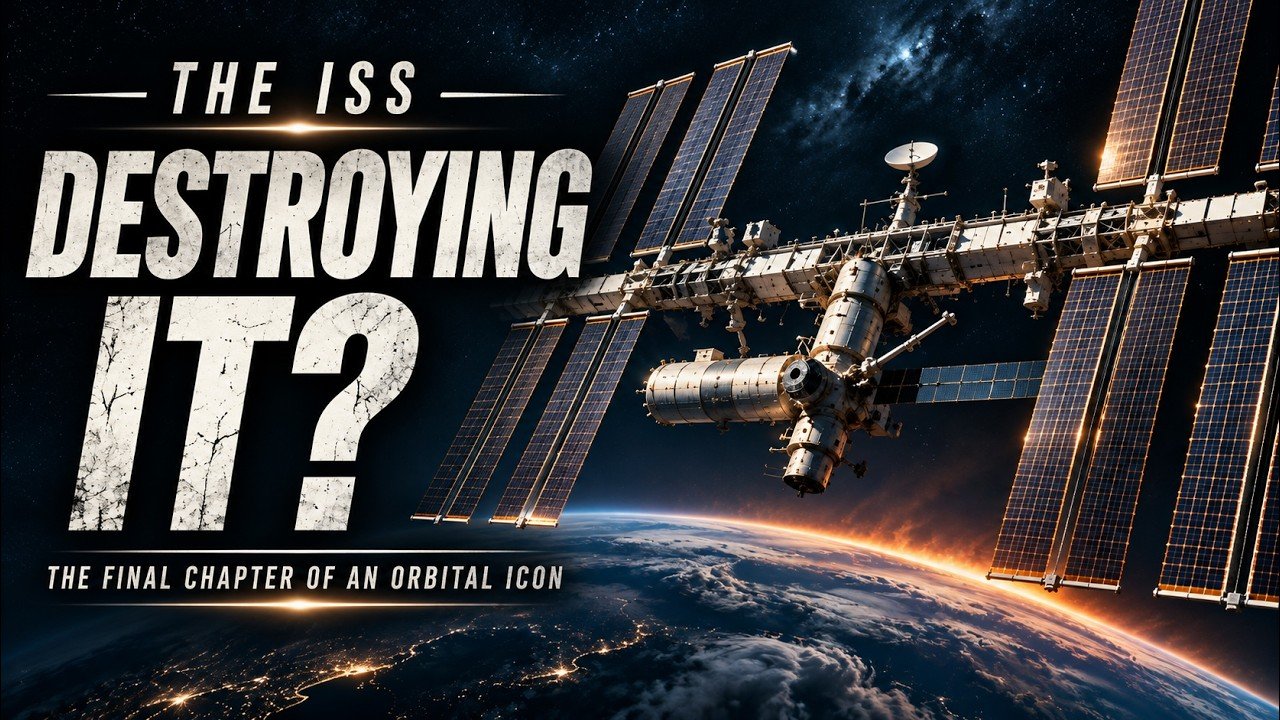
A documentary on the International Space Station, from the launch of Zarya on November 20th, 1998 and the first permanent crew in 2000 to the aging hardware, spacewalk emergencies and the leak in the Zvezda transfer tunnel. It explains why NASA and its partners plan a controlled deorbit rather than leaving the station in orbit, moving it higher or dismantling it, and says NASA selected SpaceX to develop the US deorbit vehicle.
Full written account
The International Space Station is planned to end not in an accident but in a controlled descent: NASA and its partners intend to guide it into the atmosphere so that much of it burns up and the remaining pieces fall into a remote stretch of ocean. The video's description says NASA is planning this deorbit around 2030, although the station's operational life could be extended. The station circles Earth at roughly 28,000 km an hour and has been continuously occupied for more than a quarter of a century.
Built one piece at a time
Construction began on November 20th, 1998, with the launch of Zarya, a Russian-built functional cargo block that supplied early power, propulsion and control. A few days later Space Shuttle Endeavor launched Unity, an American-built connecting module. On December 6th, the STS-88 crew used the shuttle's robotic arm to capture Zarya and join it to Unity, the first major assembly operation. In July 2000 the Russian Zvezda service module was launched, with living quarters and life support and control systems.
On November 2nd, 2000, Expedition 1 arrived aboard a Soyuz spacecraft. The crew included American astronaut William Shepherd and Russian cosmonauts Yuri Gidzenko and Sergey Krikalev. Later modules included the US laboratory Destiny, Europe's Columbus and Japan's Kibo. Canada's Canadarm2 robotic system can relocate by using different attachment points.
In February 2003 the space shuttle Columbia was lost during re-entry, killing all seven astronauts aboard. The shuttle fleet was grounded and the assembly schedule was disrupted, and Soyuz and Progress became especially important for carrying people and supplies.
Hazards of maintenance
In July 2013 Luca Parmitano of the European Space Agency was spacewalking with NASA astronaut Chris Cassidy when water built up behind his head, eventually interfering with his hearing and vision. Mission control ended the spacewalk. A later investigation linked the incident to a problem in the suit's water separation system, including contamination. In December 2013, astronauts replaced a faulty ammonia pump module in the external cooling system.
Orbital debris is another threat, and controllers can plan a maneuver when a conjunction looks dangerous. The station also experiences drag and needs periodic boosts to hold its altitude.
Aging and the Zvezda leak
The Zvezda transfer tunnel developed cracks and small air leaks, identified beginning in 2019. In June 2026 NASA reported that a change in the observed leak rate prompted additional assessments and cautious operational decisions. The video stresses that the station did not suddenly become uninhabitable, and that the decision to plan its retirement was not made solely because of the leak.
Why a controlled deorbit
Abandoned, the station would eventually descend, and some dense or heat-resistant pieces might survive to reach the surface. Moving it much higher would require an enormous amount of propellant and a large, delicate structure is not designed to be accelerated like a small satellite. Dismantling it piece by piece would take many missions and risky operations.
The plan is a gradual descent using the station's propulsion and visiting spacecraft, followed by a final targeted maneuver with a dedicated spacecraft toward an uninhabited ocean region. NASA selected SpaceX to develop the US deorbit vehicle. Solar arrays and radiators would be vulnerable early in the breakup, and the pressurized modules and truss structures would fragment further.
NASA's strategy is to transition toward commercially operated orbital destinations, though whether every planned replacement arrives on time remains uncertain.
Questions this video answers
Why is NASA planning to bring down the ISS?
The station is aging, its systems need enormous effort to maintain, and the partners have been planning a transition to new orbital laboratories. The video says the decision was not made solely because of the Zvezda leak.
Why not leave the station in orbit?
At its altitude atmospheric drag would eventually bring it down, and without control surviving debris could fall across an unacceptable area.
Who is building the US deorbit vehicle?
NASA selected SpaceX to develop it, according to the video.
When will the ISS be deorbited?
The description says NASA is planning a controlled deorbit around 2030, although its operational life could be extended.
Where would the remains fall?
The plan targets an uninhabited stretch of ocean far from populated regions.